
Our Sustainability Strategy and Approach
We strive for excellence in all that we do, continually innovating to provide high-quality food to the tables of millions of consumers worldwide, and doing our part to conserve the planet’s resources for future generations. With a global, diversified food platform and a portfolio of value-added and branded products, we aspire to be a model for profitable and sustainable food production for a growing planet – while also serving as agents for positive change in the communities where we operate.
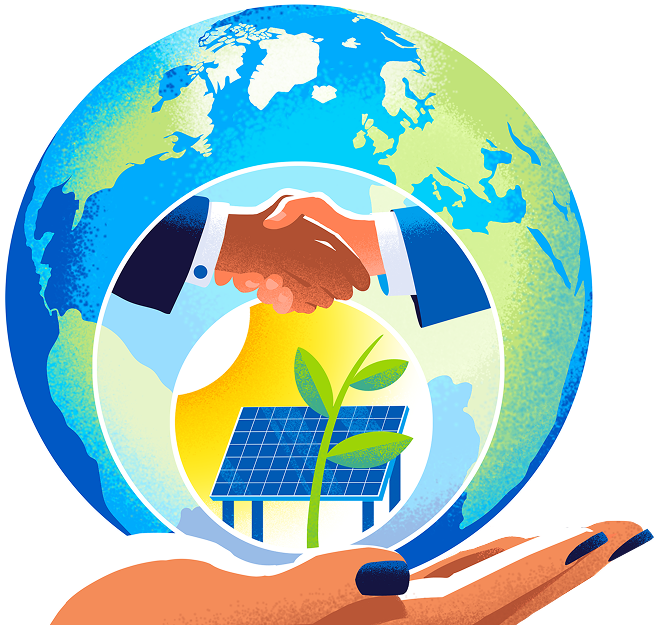
We are striving to set the food industry standard for profitable and sustainable food production for a growing planet. This means improving the sustainable performance and resiliency of not only our operations but also contributing to the enhanced sustainability of the broader food production system as a whole, while helping our customers achieve their sustainability goals.
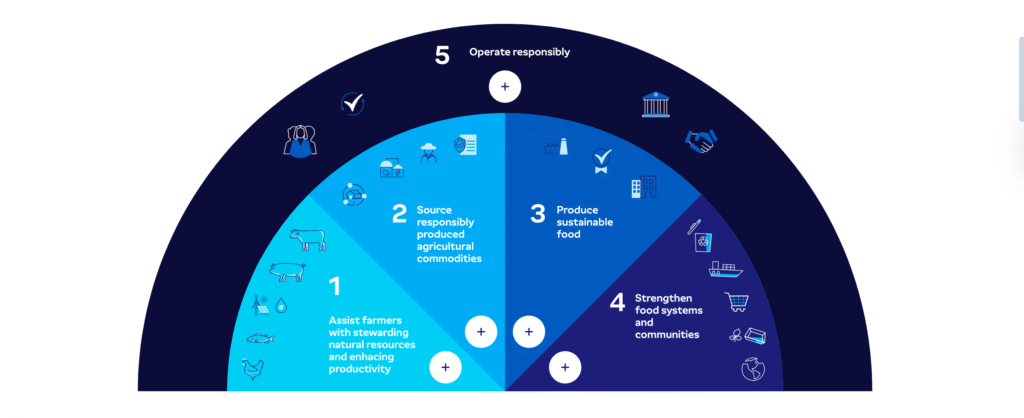
To realize this vision, our Global Sustainability Strategy mirrors our supply chain connections and addresses our material sustainability topics. This strategy will guide the company’s actions across environmental, social, and governance topics and serve as the overarching framework through which all our sustainability programs and initiatives are developed.
Sustainability Strategies Across Our Value Chain
Our Goals
1. When used herein, “net zero by 2040” or “net zero by 2040 goal” shall mean the company’s goal to achieve net-zero greenhouse gas (GHG) emissions by 2040. This goal spans the company’s global operations, as well as its diverse value chain of agricultural producer partners, suppliers and customers, and all other third parties in the company’s value chains. Whether the company is successful in achieving this very ambitious goal will depend on numerous factors outside of the company’s control, including but not limited to: legal and regulatory changes by local governments, technological innovations and infrastructure, energy advancements, economic and environmental conditions, climate change impacts, force majeures, social and cultural factors, international agreements and global trends, financial markets, collaborations and partnerships, and the resources and efforts of those in our value chains. Because of these variables, among others, the company may not be able to achieve net zero by 2040.
2. Safety Index = number of severe injuries for every 100 employees ( (Severe Injuries*200,000)/Total Hours Worked ). Severe Injury = Any injury resulting in amputation, fatality, in-patient hospitalization, vision loss, second- or third-degree burns, or fractures that results in greater than fifteen days lost time, and any other injury that results in greater than fifteen days lost time.
3. Depending on the time of receipt, Our Ethics Line cases may not be closed within the same calendar year.
4. Includes concerns about the company’s potential and actual negative impacts on stakeholders. We define these cases as those related to anti-bribery/anti-corruption (ABAC), antitrust, embezzlement, falsification of corporate documents, financial wrongdoing, theft over US$2,000, and conflicts of interest.
Key focus areas
Health & Safety
The health and safety of our team members is our priority. Our dedication begins with a culture of accountability, empowering each team member to understand and follow health and safety guidelines while staying vigilant.
We foster a culture of safety across all facilities, guided by our Global Health and Safety Policy, with continuous training and strict governance to protect every team member. Each year, our locations undergo a comprehensive safety management system audit, fleet safety audit, and occupational health audit based on applicable legislation and company procedures. These audits focus on early detection of risks and in-depth reviews of policies and programs related to preventing electrical safety issues, ergonomics weaknesses, falls and slips, and machine guarding issues.
We have integrated safety data across digital platforms to identify enterprise-wide trends and best practices related to health and safety. Data-driven insights support us in performing root-cause analysis and taking corrective actions such as audits and safety inspections. Insights also help us to define best practices that we can share across the organization.
Climate Change
Climate change and food security are two seemingly competing challenges — feeding a future world of 10 billion people with safe, nutritious, affordable food while also helping farmers and our food system reduce environmental impacts and adapt to a changing climate.
We believe we must collectively act with urgency to limit global warming and help producers adapt to its most negative effects. As a global, diversified food company, we have a responsibility to leverage our scale and influence to help lead sustainable transformation by example and empower our value chain and peers to collectively move forward. Through partnerships with governments, academia, industry associations, and others, we are working to innovate and impact one of the most pressing long-term risks facing the agricultural supply chain and dependent industries.
We have more than a decade-long history of measuring, monitoring, and reporting direct and indirect greenhouse gas (GHG) emissions and of voluntarily reporting to CDP, regional regulatory frameworks, and others. Our GHG emissions are calculated based on the World Resources Institute’s and the World Business Council for Sustainable Development’s The Greenhouse Gas Protocol: A Corporate Accounting and Reporting Standard (Revised Edition) (GHG Protocol), as well as internal criteria defined.
To strengthen stakeholder confidence in our reported emissions, we have obtained third-party assurances for our global scope 1, scope 2, and scope 3 GHG inventories.
Our Approach: At Global Win Co LLC, we believe everyone must do their part to address the impacts of climate change, and the responsibility to address the agricultural system’s footprint cannot be put on individual farmers alone. Our company is well-positioned to engage our suppliers, food system partners, and consumers on how to collectively address our shared GHG emissions and improve the resiliency and productivity of the global food system.
Our company culture has always promoted on-the-ground collaboration over off-site enforcement, and we strive to achieve our ambition to improve the resiliency of our food system to climate change through collaborative initiatives that improve both the environmental and financial performance of our supplier partners. We will prioritize key areas to strengthen climate resilience, promoting sustainable, productive value chains that support global food security.
Animal Welfare
As leaders in animal protein production, we have a responsibility to provide our animals with a good quality of life and a humane end. Across our operations, we have embedded animal welfare practices that demonstrate our respect for the animals on which our business depends. We have aligned our policies, including the Global Animal Welfare Policy, procedures with local laws and regulations, and internationally recognized standards, including the Five Domains Model, which is a framework for assessing animal welfare.
Across our operations, our approach to animal care is grounded in science, measurement, training, audits, and research. Dedicated teams oversee continuous training, facility assessments, monitoring, and compliance — all under a zero-tolerance policy for mistreatment.